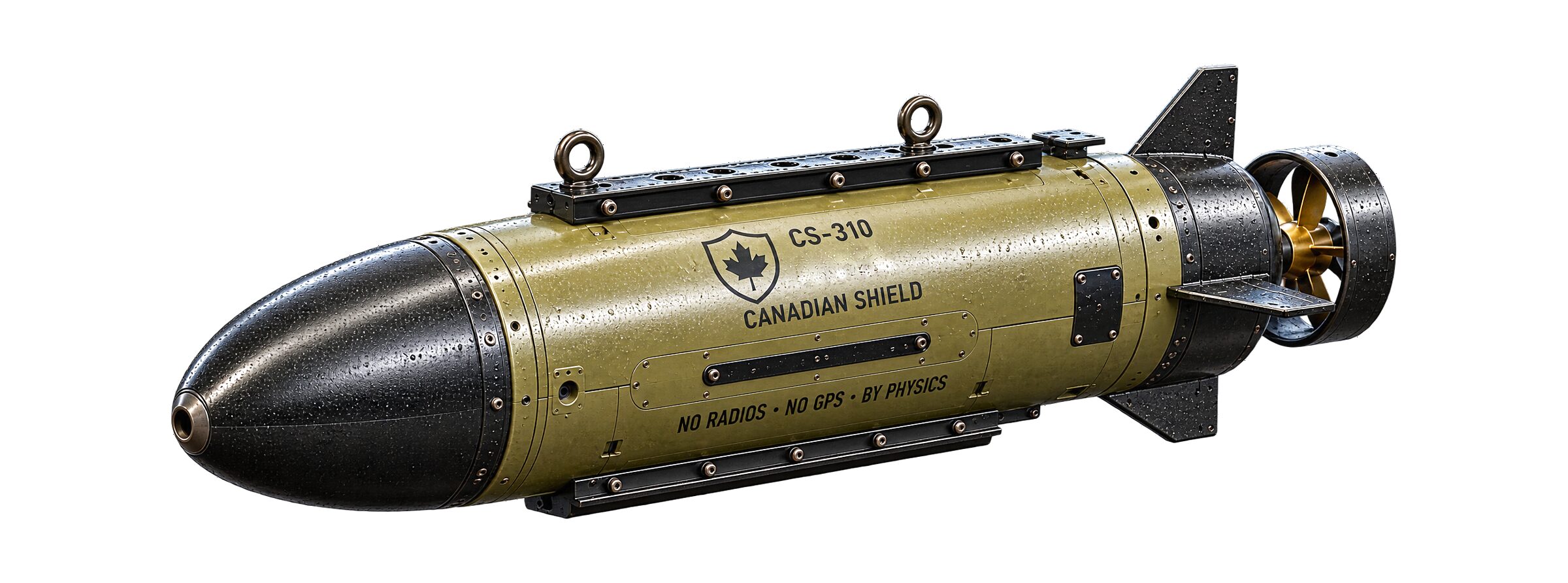
Canadian Shield builds a fleet of eleven programs across Air, Water and Underground, and CDNS KAOS on the ground. Every one of them is a carrier: no warhead, no fuze, no energetic material, and nothing in the fleet operates a weapon. No radio and no GPS aboard the fleet, with the one ruled exception: the two mine clearance configurations, KAOS-MC Land and KMM-01, carry GNSS and command links, and KMM-01 also carries a marine radar and AIS to see traffic and be seen. Jammed radio and denied GPS are the conditions an allied procurement body scopes for, and outside those two configurations neither is a dependency of this architecture. The lead program is Goose CS-110, an unpowered pneumatic interceptor round in the Air domain, and its launch chain is set out on CDNS UAV Platforms; how a platform guides with nothing in the spectrum is set out on Technology. The whole roster opens by domain at the fleet.
CDNS Autonomy converts selected existing fleets into optionally uncrewed configurations. The product proposition is not that it drives any machine. It is a machine-specific conversion pathway, built on removable interfaces to a machine's own controls, independent perception, local compute and independent safety authority. The unit sits in the seat and works the machine's own controls. It never connects to the machine's CAN bus, ECU or firmware; a fused accessory feed is the only wire. It lifts out in minutes, and the machine's physical stop and manual release always remain. It takes its work in one of three ways: loaded and sealed at the dock; a fibre tether to a person at a stand-off station; its own perception inside the same rules. One hardware family is programmed apart into two profiles, and the line has a front door of its own at CDNS Autonomy.
DoctrineAI plans. Rules govern. Humans authorize. Safety has veto.
Safety's authority is independent of the task software. The independent safety layer removes energy and holds the machine to a safe state without depending on the task computer or the AI. AI proposes and sequences the work; it can never directly energize an actuator or grant itself safety authority.
CIVIL AGENCIESResponder CS-810
Fire ground, structural collapse, hazmat, and flood and wildfire earthworks, with rubble and route clearance, for civil agencies.
DEFENCE ENGINEERINGDefender CS-820
Defender takes the seat for earthworks, berms and revetments, obstacle reduction, route and rubble clearance, remote handling and driving, on the ground and the machines defence engineering already runs, military-pattern vehicles included — each surveyed, fitted, calibrated and recorded like any other machine. Never operates a weapon. Never fires anything. The profile is set out on Defender.
Design authority, software authority, manufacturing, service and the supply chain stay under Canadian control, set out in full on Sovereignty. The shop the fleet is built in is set out on Manufacturing, and the Forward Manufacturing Cell has its own page. Where local assembly or manufacture is strategically appropriate, an allied production partner path exists.