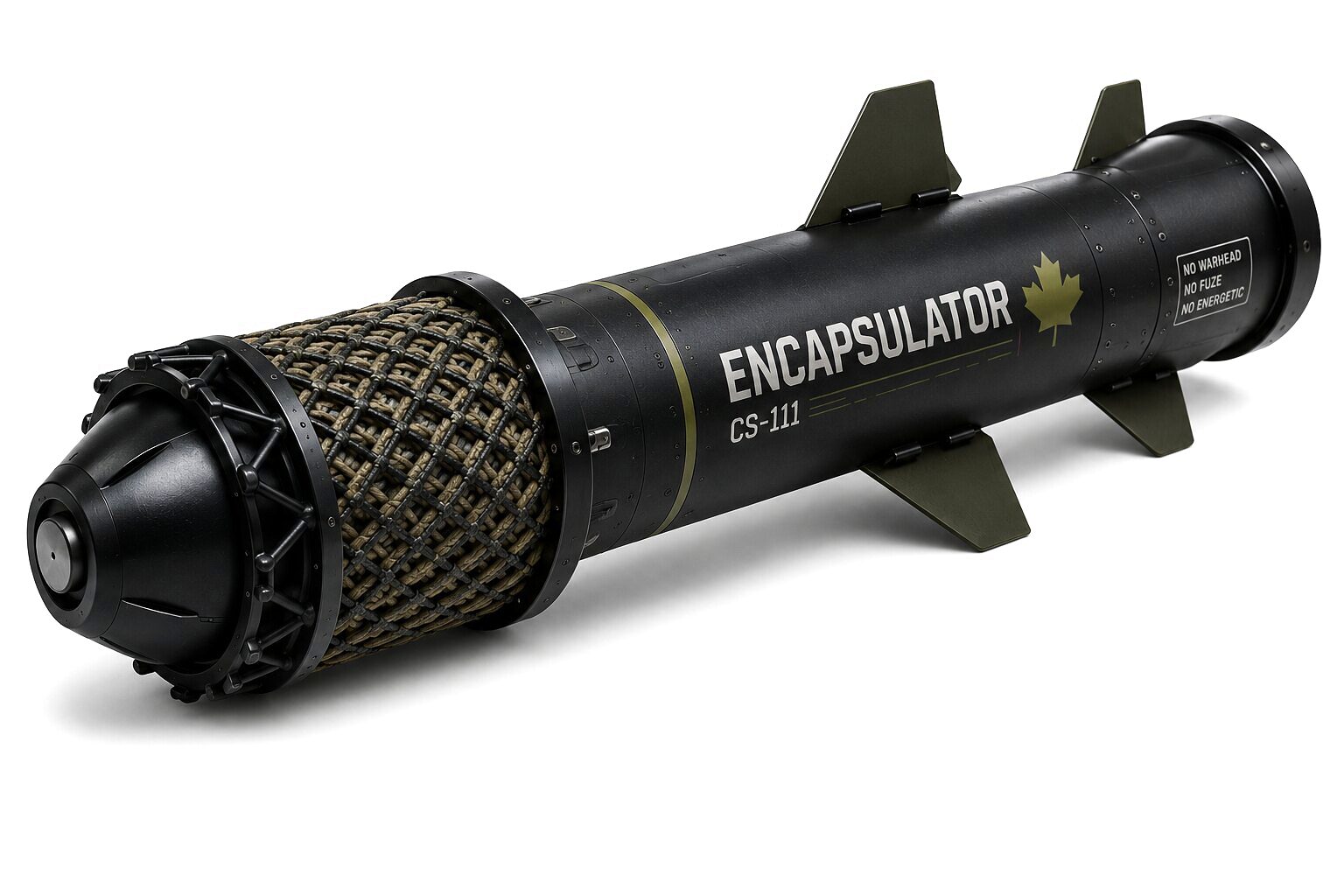
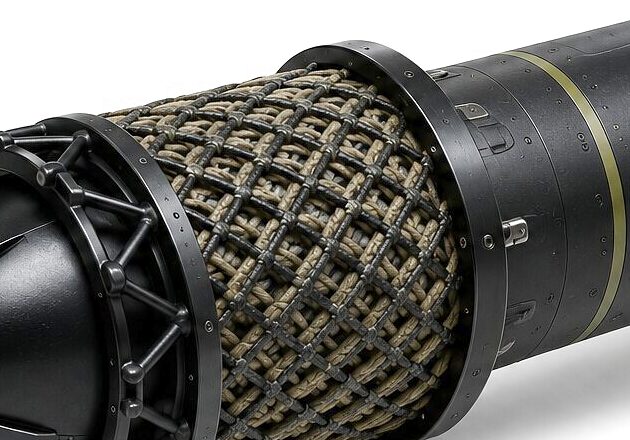
The nose of Encapsulator CS-111 with its capture bay open, a folded net held inside a black lattice frame ahead of the moulded body.
CDNS UAV Platforms · Encapsulator CS-111

The Same Round.
A Nose That Catches.


Encapsulator CS-111 is Goose CS-110 with the steel taken out of the nose and a capture bay put in its place. Same mass, same bore, same tube, same magazine pitch. What changes is the last metre.

The same round

One Round, Two Noses.
The Tube Cannot Tell Them Apart.


Encapsulator CS-111 is not a second airframe. It is the Goose round with a different nose on the same mechanical interface, and the launch platform has no way of knowing which of the two is in the breech.

Everything from the tail fins forward to the nose bulkhead is Goose CS-110, unchanged. The six fixed fins bonded into the boom lands, the Ø32 mm tail boom, the Ø70 mm moulded body, the obturator cup that takes full bore pressure across Ø90 mm: all of it is the round already defined. Forward of the bulkhead the steel slug comes out and a capture bay goes in.

Four figures are held identical on purpose. All-up mass 1.6 kg. Bore Ø90 mm on 63.6 cm². Exit velocity the same ~189 m/s. The same magazine pitch. Hold those four and the two rounds index side by side in one magazine. The operator picks an effect, not a configuration.

Encapsulator CS-111, the capture round of the CDNS UAV Platforms line, shown in profile with the capture nose forward of the bulkhead and the Goose airframe aft of it.

The launch platform is indifferent to which variant is loaded. It delivers the same 30 bar over the same 3.0 m stroke to any head, and no head carries power or signal lines from the launcher. That indifference is the commercial argument for the line: one bore, one interface, many noses, and the choice of effect taken at the breech.

The nose bulkhead

Aft of the Bulkhead,
Nothing Changes.


One structural boundary separates the two rounds. Where it sits is a design variable the bay's own contents settle, and moving it trades bay length against the body behind it.

The bulkhead is the whole of the boundary. Aft of it the round is Goose CS-110 and inherits its structure, its stability and its ballistics without alteration. Forward of it is new work: the bay, what is packed into it, and the mechanism that opens it.

The station of that bulkhead is left to the payload. Push it aft and the bay lengthens at the cost of the forward body; push it forward and the body grows back. The all-up mass is held at 1.6 kg either way, and the capture round keeps the kinetic round's external envelope and indexing features, so the two index side by side in one magazine.

What crosses the bulkhead is structure and nothing else. The nose interface on this line is a Ø64.9 mm spigot register, a Ø70 mm shoulder and a three-lug bayonet, and no electrical conductor is routed through it on any variant.

The bay

Four Elements Forward of the Bulkhead.
The Same Four Whatever the Medium.


The capture bay is a fixed envelope of mass and volume, built around four elements that stay the same whatever capture medium is packed into it.

The round is 1.6 kg all up, held identical to Goose CS-110, and everything the effect needs has to fit inside the capture nose forward of the bulkhead: a stored energy source, the capture medium, a dispersal head and the release. A mechanism that cannot be made to fit inside that nose is not a mechanism this round can carry, whatever it does at the target.

The nose bulkhead carries the payload's inertial load into the hull sidewall rather than into the dispersal head, so the launch cannot press the payload into its own release.

The bayWhat it isWhat sets it
Nose bulkheadCarries the payload's inertial load into the hull sidewallKeeps that load off the dispersal head.
Stored energy sourceCompressed gas, or a compressed spring stackHeld until the release lets it go.
Capture mediumPacked or contained in the bayThe timing arithmetic rules free-expanding chemistry out as the primary medium.
Dispersal headSets the deployed shapeWhether the medium opens into a useful curtain or a useless knot.
Mechanical releaseA positive mechanical actionHolds the bay shut through the launch stroke and needs no electrical power aboard to open.
All-up mass1.6 kgHeld identical to Goose CS-110 so the two share a magazine.

The capture bay, element by element. The four elements stay the same whatever capture medium is packed into it.

Measured against the volume an envelope has to fill, the capture nose is a hard ceiling, and that ceiling decides the effect.

The launch load

The Payload Rides
Every Metre of the Stroke.


Whatever goes into the bay is accelerated by the same stroke that accelerates the round, and it arrives at the nose bulkhead as a load rather than as a passenger.

The round leaves the tube on 30 bar of shop air over a 3.0 m stroke. Acceleration averages about 607 g over the stroke and reaches 1,159 g at the peak, the peak arriving at the very start of the stroke before the round has moved at all. Everything structural on this line is sized against the peak, and the capture bay's contents are no exception.

For the bay the consequence is arithmetic. Whatever is packed into it presses into the nose bulkhead for the whole stroke, and the bulkhead carries that load into the hull sidewall. A payload that is liquid, or that behaves like one under that load, does a second thing as well. It self-pressurizes. A 180 mm column of liquid at launch acceleration develops ~11.8 bar at its own base.

QuantityFigureWhere it acts
Average acceleration~607 gAveraged over the whole 3.0 m stroke.
Peak acceleration1,159 gAt the start of the stroke, before the round moves.
Self-pressure of a 180 mm liquid column~11.8 barAt the base of the column, during the stroke.

The launch case the capture nose is worked against. The peak sets the structure; the self-pressure sets the release.

Those two numbers, the 1,159 g peak and ~11.8 bar inside the payload itself, are the design case for the front of this round. The second also disqualifies an entire family of release mechanisms.

The release

A Burst Disc Reads the Launch
as the Target.


The neatest way to open a bay at speed is the one this round cannot use, and the reason sits in the launch load rather than in the mechanism.

A burst disc opens when the pressure behind it reaches a set value. On a static payload that is an elegant answer: no moving parts, no power, no timing. On this round it is a contradiction rather than a design.

The payload has already reached that pressure on its way up the tube. The ~11.8 bar a liquid column develops at its own base during the launch stroke sits squarely inside the range a burst disc would be set to. Set the disc below it and the bay opens in the barrel. Set it above and the impact has to deliver more pressure than the launch did, and the launch is the harder event of the two.

So the release on Encapsulator CS-111 is a positive mechanical action, held shut through the whole stroke and needing no electrical power aboard to open.

The finding
The payload self-pressurizes for the launch stroke. A pressure-triggered release is a contradiction, not a design.

The release has to be a positive mechanical action. That single line closes off burst discs, pressure diaphragms and every other threshold device on this round, and it is the reason the mechanism at the front of it is mechanical from end to end.

The vocabulary

It Opens a Bay.
It Initiates Nothing.


There is a precise word for the mechanism at the front of this round, and it is not the word a defence reader reaches for first.

Canadian Shield does not build fuzes. The mechanism at the front of Encapsulator CS-111 is a standoff release, or a deployment trigger. It opens a bay. It initiates nothing, because there is nothing aboard to initiate.

That is a statement about the hardware before it is a statement about the language. Follow the round forward from the bulkhead and the inventory is short: a stored energy source, a packed capture envelope, a dispersal head, and the mechanical release that holds the bay shut until the moment it does not.

The mechanism that opens the bay is the collapse trigger: a nose that collapses mechanically on contact, the collapse itself letting the envelope go, with no initiator, no electrical path and no proximity sensing. It is a mechanism rather than a head and carries no designation of its own, and it is set out on the heads and nose interface page.

The window

One Metre of Standoff.
Five Milliseconds to Fill.


Everything the capture nose does happens inside a window set by closing speed, and that window is the hardest constraint anywhere on the round.

Work the geometry from the standoff back. At a 1 m standoff and a 200 m/s closing speed, the envelope has 5.0 ms between the release acting and contact. That is the whole budget. Inside it the envelope has to leave the bay, expand and be in the target's disc before the round arrives.

Filling a 12 L envelope in 5.0 ms calls for about 2,400 L/s of gas, the rate class of an automotive airbag. Airbags reach it with a pyrotechnic gas generant, which the carriers-not-munitions line rules out; the design arithmetic finds that stored cold gas can reach it without one.

Cold gas

Chemistry Runs a Thousand Times
Too Slow for This Window.


A chemical medium that expands under its own reaction was the obvious first answer, and the timing arithmetic takes it out of the primary role in one step.

Commercial two-part expanding chemistries work on times of 5–15 s. The window at 1 m and 200 m/s is 5.0 ms. Free-expanding chemistry is between one thousand and three thousand times too slow to close that gap, and nothing in a formulation moves a number by three orders of magnitude.

So the path the design arithmetic favours is stored cold gas, mechanically let go. It carries a mass penalty against a chemistry that makes its own gas, and the design takes that penalty deliberately: the alternative puts a pyrotechnic gas generant on a round whose whole architecture rests on carrying no energetic material at all.

Chemistry keeps a place on the round one step further down the sequence. Used as an adhesion agent after contact rather than as the expanding medium, it works on the timescale that suits it, and the fast part is left to gas.

THE MEDIUM

Stored gas, the favoured path

A high-pressure gas bottle, the path the design arithmetic favours, and a folded envelope. No combustion, no gas generant, and nothing that has to be set off to work.

THE TRIGGER

A mechanical release

Held shut through about 607 g averaged over the stroke and 1,159 g at the peak, and opened with no electrical power aboard. No threshold device, no pressure switch, no initiator.

THE ADHESION

Chemistry, after contact

An optional post-contact agent rather than the expanding medium. It runs on seconds, and seconds are there once the envelope is already in the disc.

The effect

Foul One Rotor.
Unbalance the Whole Disc.


What the capture nose reaches at the target is narrower than the word most capture systems use for it, and it is still a capture. The arithmetic decides which word is right.

Start with the volume. Wrapping even a small multirotor whole takes far more mass than the bay can carry, and no packing arrangement recovers a shortfall of that size.

So the effect Encapsulator CS-111 is designed for is rotor fouling. The envelope goes into the disc, the disc loses its balance, and the aircraft comes down. On a small multirotor one or two fouled rotors are enough.

Fouling is what makes the standoff geometry matter. The envelope has to be in the disc, not near it, and a metre at 200 m/s is a place, not a moment that can be guessed on the ground. A preset round flies the arc it was given and cannot see a moving target, and that decides the guidance tier.

Guidance

A Preset Round Cannot Know
Where the Target Will Be.


Goose CS-110 asks for nothing after the muzzle. For the capture round the recommended primary tier is Tier 2: a fibre paid out of the tube, with a person in the loop.

The kinetic round is Tier 1, preset on the ground. There is no battery, no motor, no receiver, no servo, no sensor, no indicator and no initiator aboard it. It is aimed, it flies, and it needs nothing after the muzzle.

The capture round asks for more. Its envelope has to be in a moving target's disc, and a round set before launch cannot know where that target will be when it arrives. So the systems engineering recommends Tier 2 as the primary tier for Encapsulator CS-111: a fibre paying out of the tube, and a person in the loop.

A fibre is a wire, and nothing on it radiates. No radio and no GPS aboard the fleet, with the one ruled exception: the two mine clearance configurations, KAOS-MC Land and KMM-01, carry GNSS and command links, and KMM-01 also carries a marine radar and AIS to see traffic and be seen. Nothing on this line transmits by radio or guides on a link, and the tier does not change that.

The three tiers, and where each program on this line sits, are set out on the guidance page; the framework behind them belongs to technology.

Interchangeable

Two Effects.
One Magazine Pitch.


Holding mass, bore, exit velocity and pitch identical across two rounds is an operational decision rather than an aesthetic one. It is what lets a single magazine carry both.

A magazine that holds one effect forces the choice at loading, hours before the cue arrives. A magazine that indexes both leaves the choice at the breech, shot by shot: kinetic where a collision is the right answer, capture where the airframe should come down in one piece.

Holding that open costs the design something, and it is paid at the front of the round. Mass is held at 1.6 kg, and the capture round keeps the kinetic round's external envelope and indexing features. The bulkhead station moves with the payload.

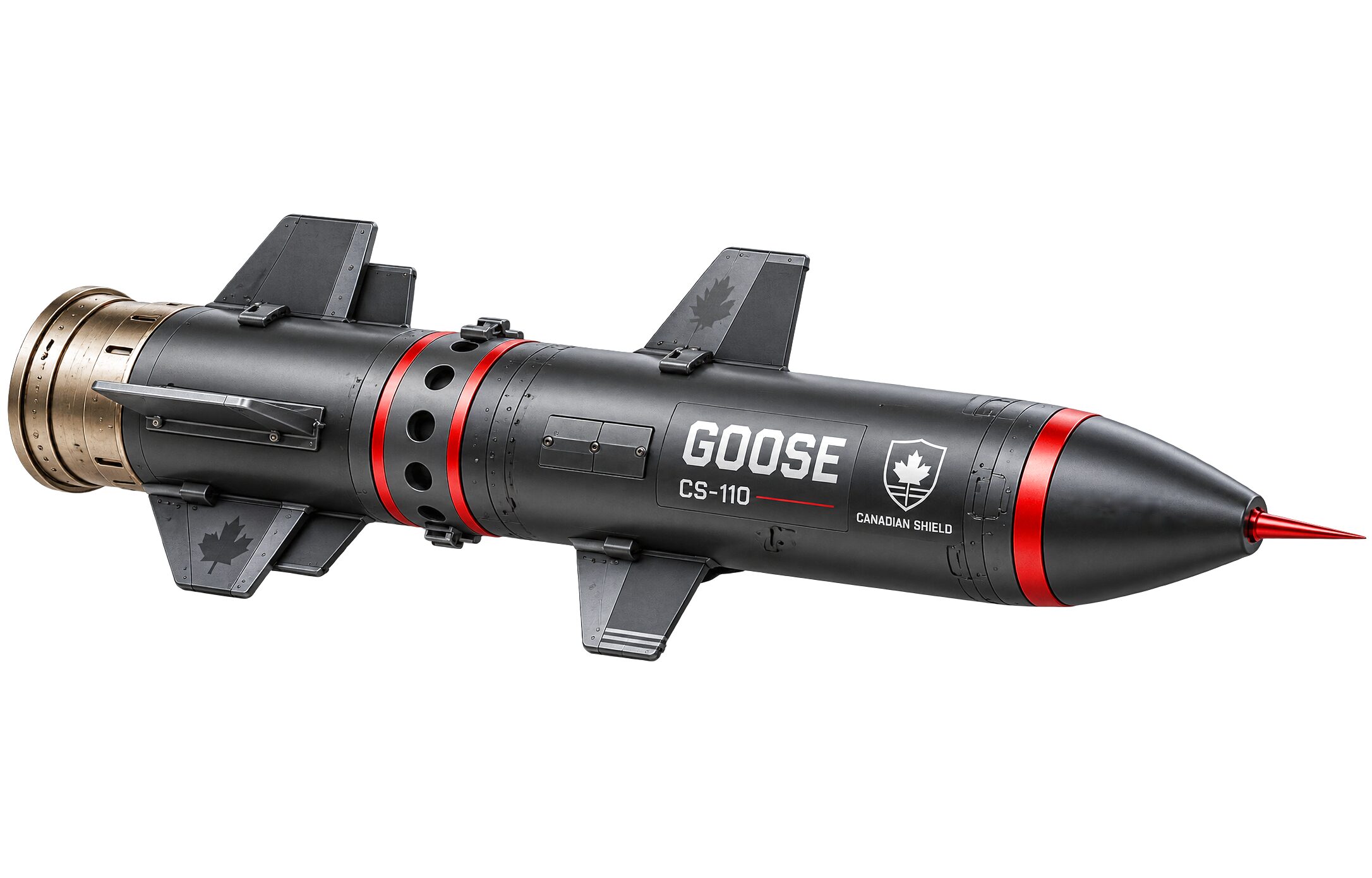
The Goose CS-110 round seen from the side, its tail cap and fin set at one end and its nose at the other.
The Encapsulator CS-111 round seen from the side, the packed capture envelope carried behind its nose.
Goose CS-110Encapsulator CS-111
All-up mass1.6 kg1.6 kg, held identical
Bore · obturator ODØ90 mm on 63.6 cm²Ø90 mm on 63.6 cm²
Exit velocity~189 m/s~189 m/s
Magazine pitchOne pitchThe same pitch — the two index together
The noseA solid steel slugA stored energy source, a capture medium, a dispersal head and a mechanical release
At the targetKinetic collisionRotor fouling, and the airframe comes down intact
Guidance tierTier 1, presetTier 2, fibre
Energetic materialNoneNone
Electrical path at the noseNoneNone

The two rounds side by side. The four rows at the top are held identical by design so the pair index in one magazine; the rows beneath them are the whole of the difference.

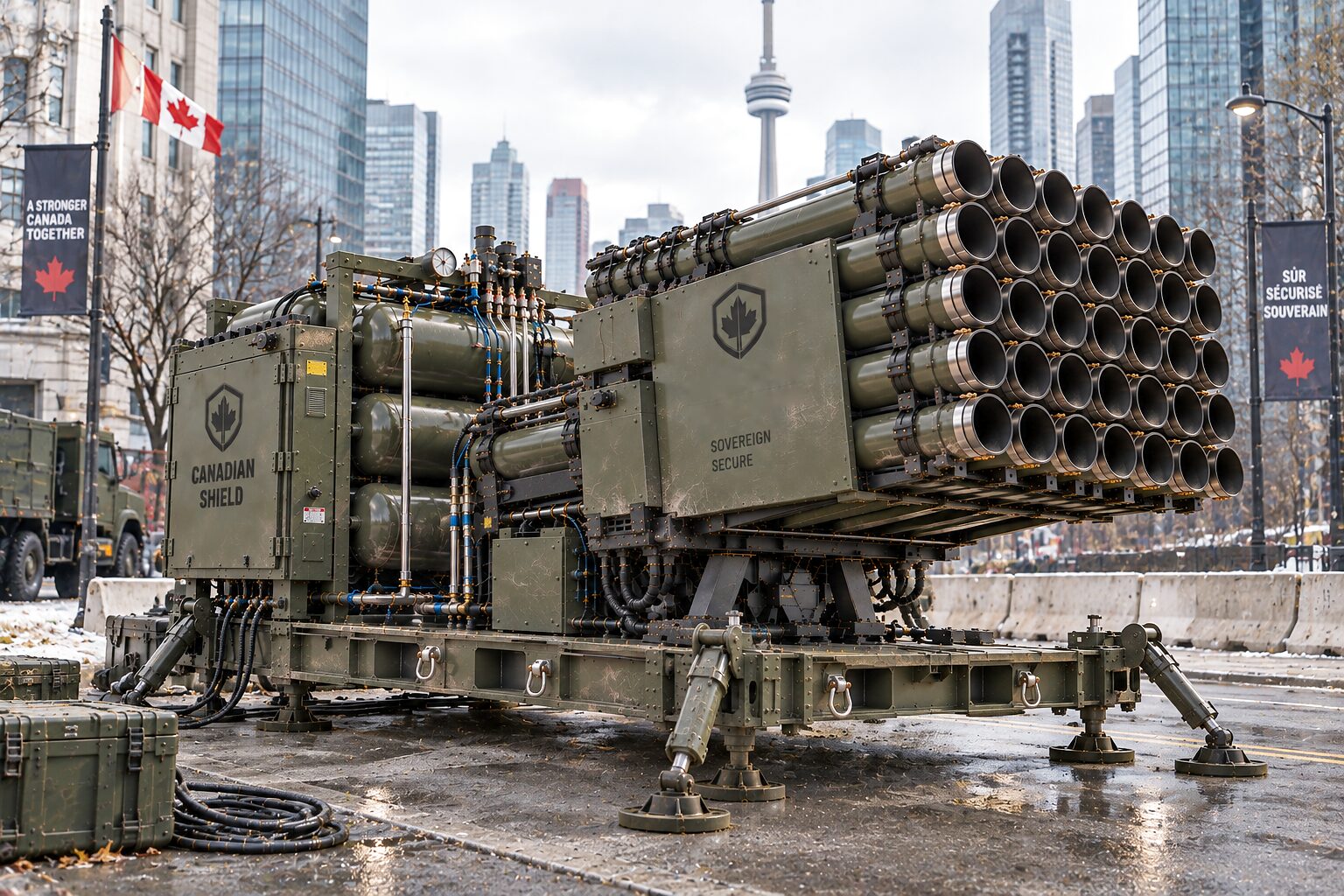
The launch platform standing on its jacks on a city street in winter behind concrete barriers, its tube array raised, with bare trees, street banners, a Canadian flag and an observation tower on the skyline.
Cold

Minus Thirty Is the Design Case,
Not the Exception.


A Canadian air-defence layer is sized for Canadian ground, and the capture nose carries an environmental design case to match.

The environmental design case for Encapsulator CS-111 is −30 °C. That figure asks more of a capture round than of a kinetic one. A steel slug is indifferent to the weather. A stored gas, a folded envelope and a mechanism that has to move inside five milliseconds are not.

Cold reaches the pressure in the bottle, the stiffness of the envelope's fold and the friction in the release, and each of those is a design input rather than a footnote. The case is carried through the whole train, from the bottle to the bay door, because it is the ground this line is meant for.

At the target

The Aircraft Comes Down.
It Comes Down in One Piece.


A capture nose ends an engagement without destroying what it caught, and the object itself, rather than a debris field, is the reason the round exists.

Encapsulator CS-111 carries no warhead, no fuze and no energetic material, and neither does the launch chain that puts it up. There is nothing aboard to burst, nothing to fragment and nothing to shower over whatever is underneath.

What reaches the ground is an intact airframe. Whoever needs to know what was overhead, where it came from and what it was carrying has the object itself to work from.

The round itself still flies the launch line's arc. A captured aircraft still falls, and a round that misses lands with 7.3 to 16.8 kJ, so for every head the full muzzle arc and the ground downrange are an exclusion zone, kept clear while the launcher is armed and firing. Human safety comes first on every line Canadian Shield builds, and the safety page carries the launch line itself.

IN THE MAGAZINE

Nothing energetic, anywhere

No warhead, no fuze, no primer, no propellant, no gas generant and no initiator, on the round or in the magazine. Pneumatic launch keeps it that way from the tube forward.

AFTER THE ENGAGEMENT

An object, not a debris field

The airframe comes down whole, so what was overhead can be recovered, examined and handed on.

BESIDE THE KINETIC ROUND

One magazine, two answers

The same tube, the same drill and the same launcher laying the shot. The engagement loop is unchanged; the operator picks the effect at the breech.

Fit

Who Needs the Target Back Whole.
And Who Should Read Goose Instead.


Encapsulator CS-111 answers one question well and refuses several others outright. Read both columns before an enquiry.

WHO IT IS FOR

Ground where an intact airframe matters

  • An air-defence planner covering a site with people, plant or traffic underneath it, who needs an effect that puts nothing energetic over the ground.
  • A force protection cell already running the launch chain for Goose CS-110 and wanting a second effect in the same magazine.
  • An operator who needs what was overhead recovered whole rather than scattered.
  • A safety officer reading a line that carries no energetic material anywhere in it, from magazine to target.
  • A buyer who wants the effector end of the chain and the cue from one company: detect, track, classify and cue are Canadian Shield's own, built in-house.
  • A procurement team weighing depth of magazine against complexity per round.
WHAT IT IS NOT

Read this before the enquiry

  • Not a munition. A capture nose catches; nothing on this line carries a warhead, a fuze or any energetic material, and nothing on it operates a weapon.
  • Not a system that wraps a whole airframe. The effect is rotor fouling, and the arithmetic behind that word is on this page.
  • Not a radio system. Nothing on this line transmits by radio, and nothing on it guides on a link.
  • Not an automated engagement. A human arm action is mandatory for every shot, and the cue is a permissive, never a trigger, that can never bypass the manual interlock chain.
  • Not a sensor. The launcher and the round carry no sensing for finding a target. Detect, track, classify and cue are Canadian Shield's own, built in-house, and sit outside them; the cue arrives on a wire as a permissive, never a trigger.
  • Not interchangeable with CS-120, which is a heavier class on its own bore, its own pressure and its own launcher.
  • Not an offer. Every enquiry is screened, international transfer is subject to Canadian government permits taken per shipment, and counsel comes first.
The conversation

Bring Us the Airspace
You Need Left Intact.


The first conversation is about the ground, what comes over it, and what has to survive the engagement.

Tell us what sits underneath the airspace, what is coming across it, and what you need left of it afterwards. From there the conversation is the launch chain as a whole: the launch platform, the magazine, the engagement loop and the split between the two effects. The CDNS UAV Platforms hub carries the line end to end; the capture nose is the part of it this conversation turns on.

All CDNS UAV Platforms designs are patent pending; international transfer is export-controlled and subject to Canadian government permits taken per shipment, and nothing on this page is an offer.